
Droplet To Plate (DTP)
StudioRIP Droplet to Plate 24/36
Computer to Plate (CTP) system that produces conventional offset plates of laser quality (175 lpi), plate sizes up to 61 × 100 cm, cheap consumables (6.5–7.8€/sqm). Used by many printers with success.
TECHNOLOGY
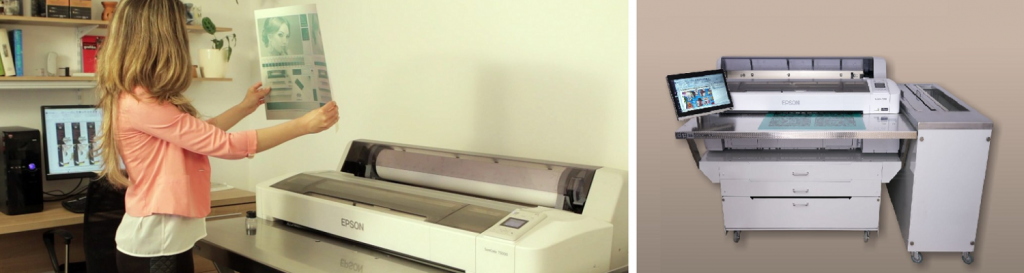
StudioRIP DTP 24/36 is a CTP (Computer to Plate) system that uses an inkjet printer for producing offset plates. Unlike most inkjet CTP systems, the plates produced by the DTP system are conventional UV plates that look and behave in the same way as any film masked conventional plate does, but its costs are much smaller (similar to thermal CTP costs). On its turn, the cost of the new, warranty covered equipment is a fraction of a laser CTP price. Although the DTP plates are conventional, they have an additional inkjet coating (similar to what photo papers have) applied in the factory over the photosensitive layer. The plates are imported by StudioRIP Ltd.
The plates are produced as follows:
- Buy the conventional plates with inkjet coating from StudioRIP Ltd. (or its dealers). The plates come in sealed boxes from the factory.
- Align the plate on the front tray to the 3 positioning pins which are automatically activated by the sensors when the plate has the proper position, then let the printer load the plate.
- The printer writes the image with black ink in about 7 minutes for a 510 × 400 mm plate (larger plates print in proportionally more time).
- The printed plate is exposed by the UV LEDs in the upper drawer, the exposure time being controlled by the system.
- Place the plate into the vertical washing tank of the plate processor using the plate holder frame. The ink and the coating are washed off by the running water. The plates can also be washed in a conventional plate washer under a jet of water.
- Move the washed plate into the developer tank, where the chemicals are recirculated.
- Move the processed plate into the washing tank again. All processing stages are controlled by the system.
- The washed plate can be used by the printing press. It will behave like any other conventional plate.
COMPONENT
1. Printer:
- DTP 24: Epson SureColor T3200 with 61 cm printable width, or
- DTP 36: Epson SureColor T5200 with 90 cm printable width
2. The unit under the printer, containing:
- positioning system with 2 sensors and 3 solenoids (on the front tray),
- exposure system (in the upper drawer with UV LEDs),
- drawer for plates (lower drawer),
- exposure and plate processing controller with LCD display.
3. Washing and processing unit, containing:
- vertical washing tank (the plate is washed before and after processing),
- vertical processing tank,
- recirculation pump,
- replenishment pump,
- electrovalve for the running water,
- dryer compartment, yet unused,
- Stainless steel frame for handling the plate in the processor.
4. PC containing:
- decent configuration for RIP (dual core, 500 GB HDD, 2 GB RAM),
- StudioRIP 4.0 Inkjet Edition 24 + imposition + proofing license,
- no monitor, mouse, keyboard, the system being controlled by the StudioRIP Client application through the network.
5. Optional:
- transport and installation at the customer (depending on the distance),
- second controller + display for the plate processor unit, in case it isn’t installed beside the CTP unit (200€).
Resolution (the number of droplets that can be printed on one inch):
- 2880 × 2880 dpi
Line screen (the number of halftone dots per inch):
- 133, 150 and 175 lpi (recommended line screen: 175 lpi)
Speed:
- Approx. 8–10 A3 plates per hour (the printing time increases with the printed area)
Printable area:
- DTP 24: 61 × 100 cm (plates longer than 61 cm are recommended though to be printed by DTP 36 due to non-printable area and registration issues);
- DTP 36: 90 × 150 cm
Relative registration precision (maximum registration error on the optimal alignment of the marks):
- Typical: 0,025 mm, maximum: 0,1 mm for 430 × 550 mm plates
- Typical: 0,05 mm, maximum: 0,2 mm for 430 × 550 mm plates
Absolute registration precision (registration error on the plates aligned by edges):
- Typical: 0,1 mm, maximum: 0,5 mm (assuming proper plate loading)
Geometrical precision (length error compared to a ruler):
- Typical: 0,1 mm, maximum: 0,2 mm
Color precision after calibration (density difference between measured and nominal values):
- Typical: ±1.5% (e.g. 50% measures between 48,5–51,5%), maximum: ±3%
Text quality:
- Very difficult to distinguish from laser plates; similar or even better quality than plates made with film.
Halftone quality:
- Very difficult to distinguish from laser plates; similar or even better quality than plates made with film.
Other quality related phenomenons:
- the smallest halftone dot is of 35–40 microns (therefore shades under 5% use hybrid screening); these dots are very difficult to see with naked eye, but offer better printing stability
- the uniformity of the dots isn’t perfect (similar to plates made with film, under the microscope a slight size and shape variation can be seen), causing slightly «noisier» halftones; on the final print this is almost impossible to distinguish from prints made with laser plates though.
- certain unfortunate combinations of printer, plate thickness, shade and lpi might produce a slight banding; in case the banding can be seen on the final print, a smaller line screen should solve the problem (e.g. 150 lpi instead of 175 lpi).